Radio in Transition: Current Perspectives and Challenges
DOI:
https://doi.org/10.56418/txt.20.1.2026.0Keywords:
Radio, Transition, Editorial, Textual & Visual MediaAbstract
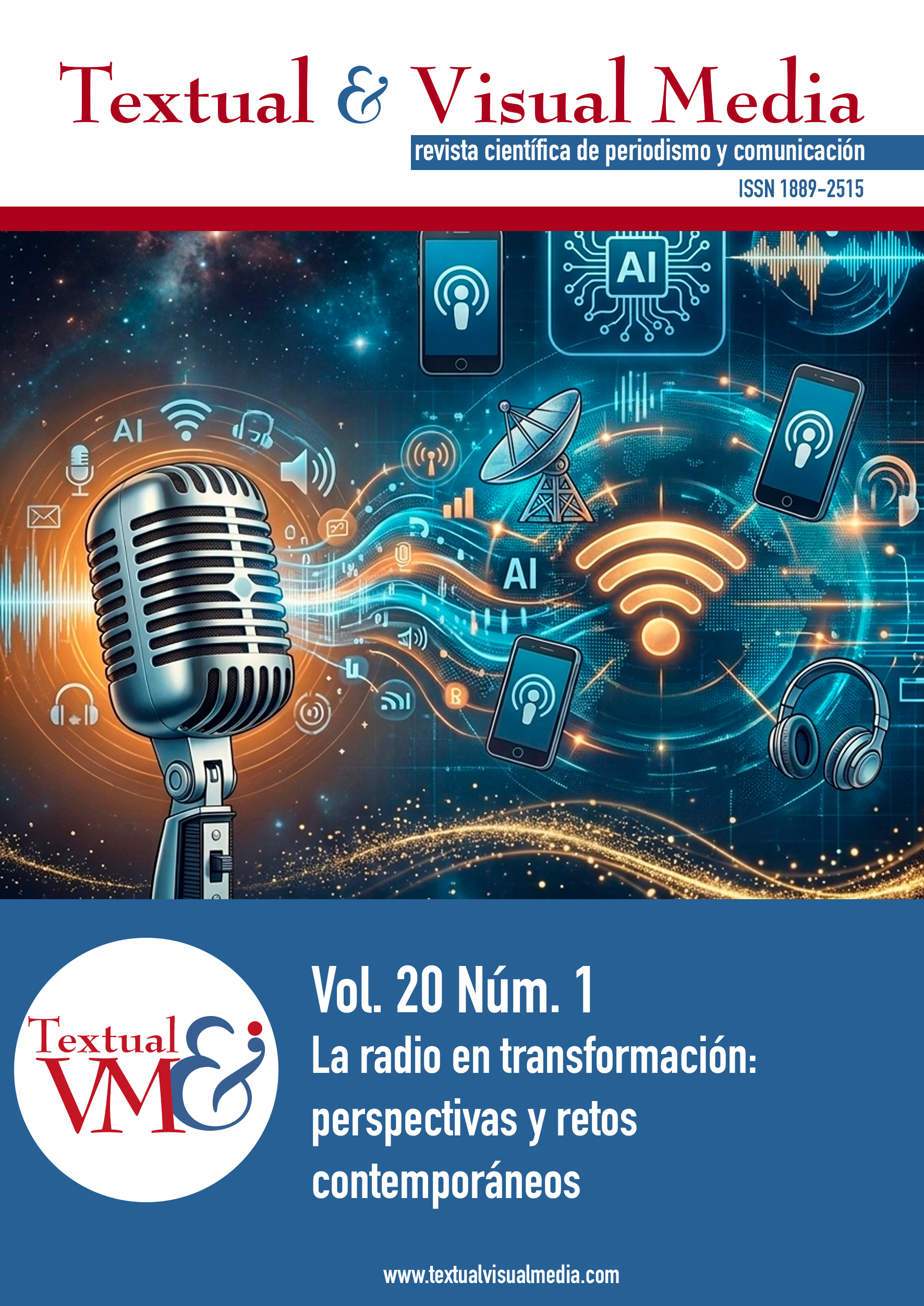
Radio is experiencing the paradox that accompanies all long-lived media: the more people talk about its demise, the more evident it becomes that it is not disappearing, but changing. More than a century after the first regular broadcast, the audio signal remains one of the most trusted and widespread ways in which the public accesses information, music and social debate (Hendy, 2000; Lacey, 2018). At the same time, however, the radio that today’s listener uses differs from its analogue predecessor just as significantly as the postal service differs from instant messaging. Traditional linear broadcasting coexists with podcasts, smart speakers, voice assistants, streaming services and synthetic voices generated by artificial intelligence; radio professionals are shifting from the role of ‘guardians of the broadcast structure’ to that of curators, data analysts and educators of the audience within an audio environment that is becoming fragmented, personalised and algorithmically recommended (Newman, 2024; Sellas & Bonet, 2023). This monographic issue of the journal Textual & Visual Media therefore asks the most fundamental question: what does ‘being radio’ actually mean today, and which of its transformations remain technological, which economic, and which – perhaps most importantly – social.
Downloads
References
Alonso-López, N., López-Olano, C. & Gamir-Ríos, J. (2025) Video podcasting español en YouTube y Spotify: conversacional y profesionalizado. Index.comunicación, n.o 15(2), 249–274 DOI: https://doi.org/10.62008/ixc/15/02Videop
Berry, R. (2016). Podcasting: Considering the evolution of the medium and its association with the word “radio”. The Radio Journal: International Studies in Broadcast & Audio Media, 14(1), 7–22. https://doi.org/10.1386/rjao.14.1.7_1
Brník, A., Bôtošová, Ľ., & Kapec, M. (2020). Radio Production and Practice. Faculty of Mass Media Communication, UCM in Trnava.
Brník, A., & Paučin, M. (2026). The perception of male and female voices in radio broadcasting. Media Literacy and Academic Research, 9(1). https://doi.org/10.34135/mlar-26-01-08
Crisell, A. (1994). Understanding radio (2nd ed.). Routledge. https://doi.org/10.4324/9780203131275
European Parliament and Council of the European Union. (2024). Regulation (EU) 2024/1689 on artificial intelligence (AI Act). Official Journal of the European Union. https://eur-lex.europa.eu/eli/reg/2024/1689/oj
Furtáková, L., & Janáčková, Ľ. (2023). AI in radio: The game changer you did not hear coming. In Marketing Identity: AI – The Future of Today (Conference Proceedings). Faculty of Mass Media Communication, UCM in Trnava. https://doi.org/10.34135/mmidentity-2023-09
Hendy, D. (2000). Radio in the global age. Polity Press.
Kay, J. B. (2020). Gender, media and voice: Communicative injustice and public speech. Palgrave Macmillan. https://doi.org/10.1007/978-3-030-47287-0
Lacey, K. (2018). Auditory capital, media publics and the sounding arts. In M. Bull (Ed.), The Routledge companion to sound studies (pp. 13–22). Routledge. https://doi.org/10.4324/9781315722191
López-Olano, C., Alonso-López, N. y Bañon-Castellón, L. (2025) ”IA y Pódcast: la recreación de voces de personajes históricos en España” In: Tania Fernández-Lombao, Miguel Túñez López y Madalena Oliveira (Coord.) El audio del futuro en los Medios de Servicio Público. Fragua. ISBN: 979-13-99066-28-9 pp: 61-74
Newman, N. (2024). Reuters Institute digital news report 2024. Reuters Institute for the Study of Journalism. https://reutersinstitute.politics.ox.ac.uk/digital-news-report/2024
Pedrero-Esteban, L.M., Martínez Otón, L. & Escobedo Pareja, E. (2023). El audio digital en la era omnicanal: contenidos, formatos y métricas. In M. Perlado Lamo de Espinosa, N. Papi Gálvez y M. Bergaz Portolés (Coords.), Audiencias y medios digitales: más allá del dato, (pp. 83–94). Tirant Lo Blanch.
Sellas, T., & Bonet, M. (2023). Independent podcast networks in Spain: A grassroots cultural production facing cultural industry practices. Convergence: The International Journal of Research into New Media Technologies, 29(5), 1265–1283. https://doi.org/10.1177/13548565231157777
Singh, C. L. (2024). Implications of AI and the metaverse in media and communication spaces. SN Computer Science, 5, Article 1098. https://doi.org/10.1007/s42979-024-03415-x
Published
How to Cite
Issue
Section
License
Copyright (c) 2026 Textual & Visual Media

This work is licensed under a Creative Commons Attribution-NonCommercial-ShareAlike 4.0 International License.